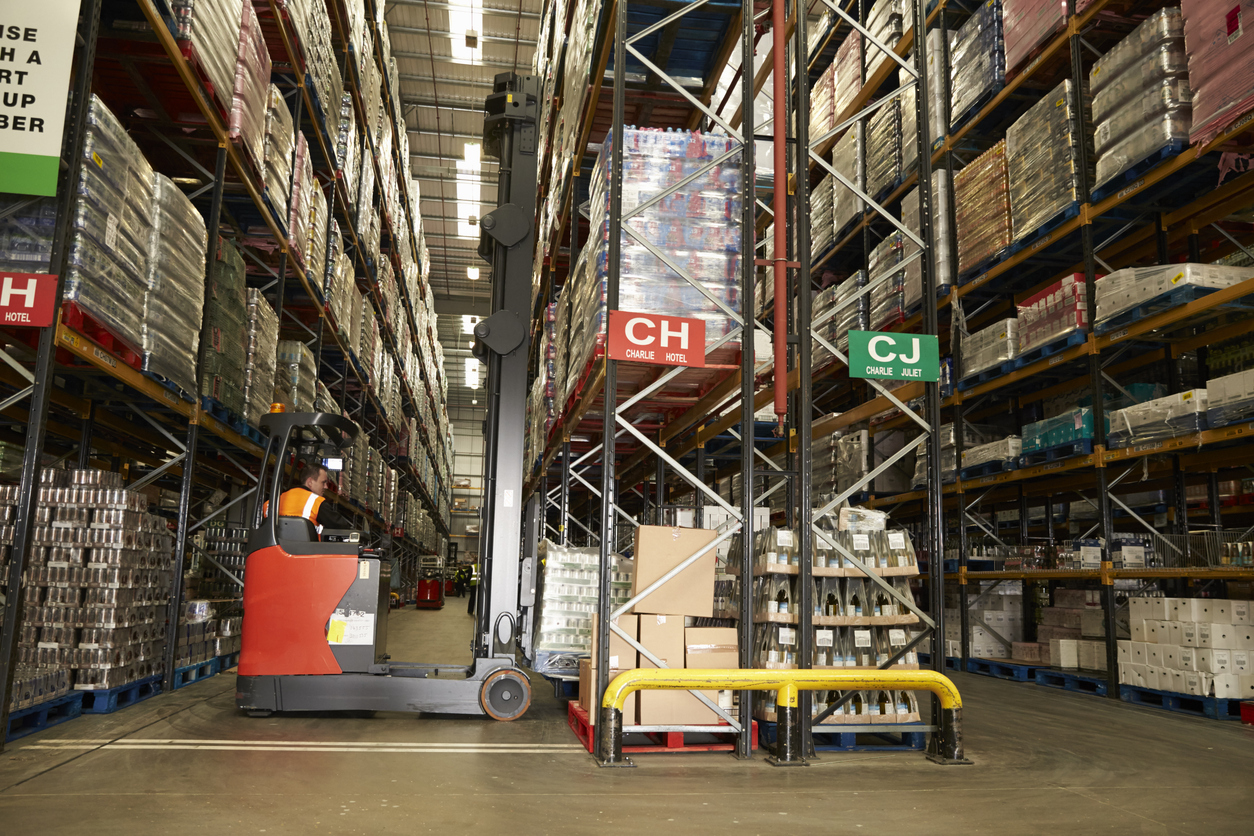
Not all pallet racking systems are equal. Actually, systems for a high-volume single-SKU cold store and a 3PL with thousands of product lines are incomparable. Below, I’ll be honest about the strengths and weaknesses of most pallet racking systems.
Selective Racking
Selective racking, the most deployed system in the UK, is the most optimal racking system for the majority of operations. The system is set so each pallet position is independently accessible meaning you can reach a pallet without moving others.
The one downside is density. Selective racking, on average, uses 40-50% of pallets for aisles. As a result, selective racking systems take up a significantly larger share of floor space. Selective racking is ideal for operations with product range, picking, and stock rotation. The larger aisle share is justified by the time savings on floor space for picking products.
Not only is selective racking the best choice for flexibility, but selective racking is also the most easily reconfigured out of all racking designs. Racks can have their beams positions and heights altered. Bays can be added and removed. The construction consists of modular components. If your facility design necessitates a change in the next 3 years, selective racking changes with it more easily than most alternatives.
Drive-In and Drive-Through Racking
The aisles are eliminated with drive-in racking. Here, the forklift is driven into the racking and loads and retrieves pallets from rails placed on either side. The storage density is unbelievable, meaning that racking can store more pallets using the same amount of floor space than is possible using selective racking.
However, there is a trade-off in terms of access. The pallets stored in the back of the racking are more difficult to access than the pallets that are stored in the front, meaning that the system must operate on a last-in, first-out (LIFO) basis. Drive-in racking is not suited to fast-moving operations that require a more granular stock rotation.
Drive-through racking is a variation of this type of racking. In this type of racking, the access is from both front and rear, allowing for first-in, first-out (FIFO) stock rotation. For this racking system, less storage density is used for aisles between racks.
Drive-in racking is designed for bulk storage of products with less stock rotation demand. Cold storage is ideal for this fitting system of racking.
Push-Back Racking
Push-back racking can be thought of as a compromise between selective racking and drive-in racking. Within a single storage bay, pallets are loaded onto a series of nested carts or rails. Loading a new pallet pushes all back pallets back. To retrieve a back pallet, the remaining pallets will roll forward.
Similar to drive-in racking, the system operates on LIFO. However, all lanes are independent. Operating configurations usually run between two to five pallets deep.
Push-back racking is a good option for higher density storage than selective racking, and with more accessibility than providing a drive-in racking system. The limitations with push-back racking focus on lane depth. Push-back is best for a high volumne and low SKU situation. For a higher SKU situation, lane density quickly vanishes on a drive-in racking system.
Narrow Aisle and Very Narrow Aisle Racking
Narrow and very narrow aisle storage systems achieve the same targets of selective racking accessibility but with a narrower aisle width. Reach trucks require about a 2,700 mm aisle, while counterbalance forklifts require about a 3,500 mm aisle. Very narrow aisle equipment require as little as a 1,600 mm aisle.
These narrower aisle widths allow for more rows of racking and a more dense (> 50% increase) racking system when compared to standard systems. This is a significant change in a high cost storage location.
Many compromises must be considered when choosing an operation method and equipment. Cheaper and beginner options are available for most of the methods described, but a higher consideration of skills and costs is needed to operate a Narrow Aisle type of racking. Due to the nature of Narrow Aisle storage and all of the equipment needed, including the custom racks, this type of method is used for larger distribution centers, where the justified value of the equipment and higher volume of throughput is compared to the construction costs of the center.
Which method is most effective
Wide range of different products being frequently picked requires the most basic type of racking, the selective type, a recommendation almost always.
Bulk storage with few stock keeping units (SKUs) and no requirement for rotation requires the most basic type of racking, the drive-in.
Medium density with a requirement for more accessibility requires the push-back.
High-value building space, volume operation, and availability of specialist equipment requires either the use of the multiple Narrow or Narrow Aisle equipment.
If these descriptions do not fit your situation, more specific details would be needed before a decision is made. In practice a combination of each of the different systems described is more common. Most mixed operations fall under the combination of selective racking for picking lines and drive-in bulk storage for replenishment.