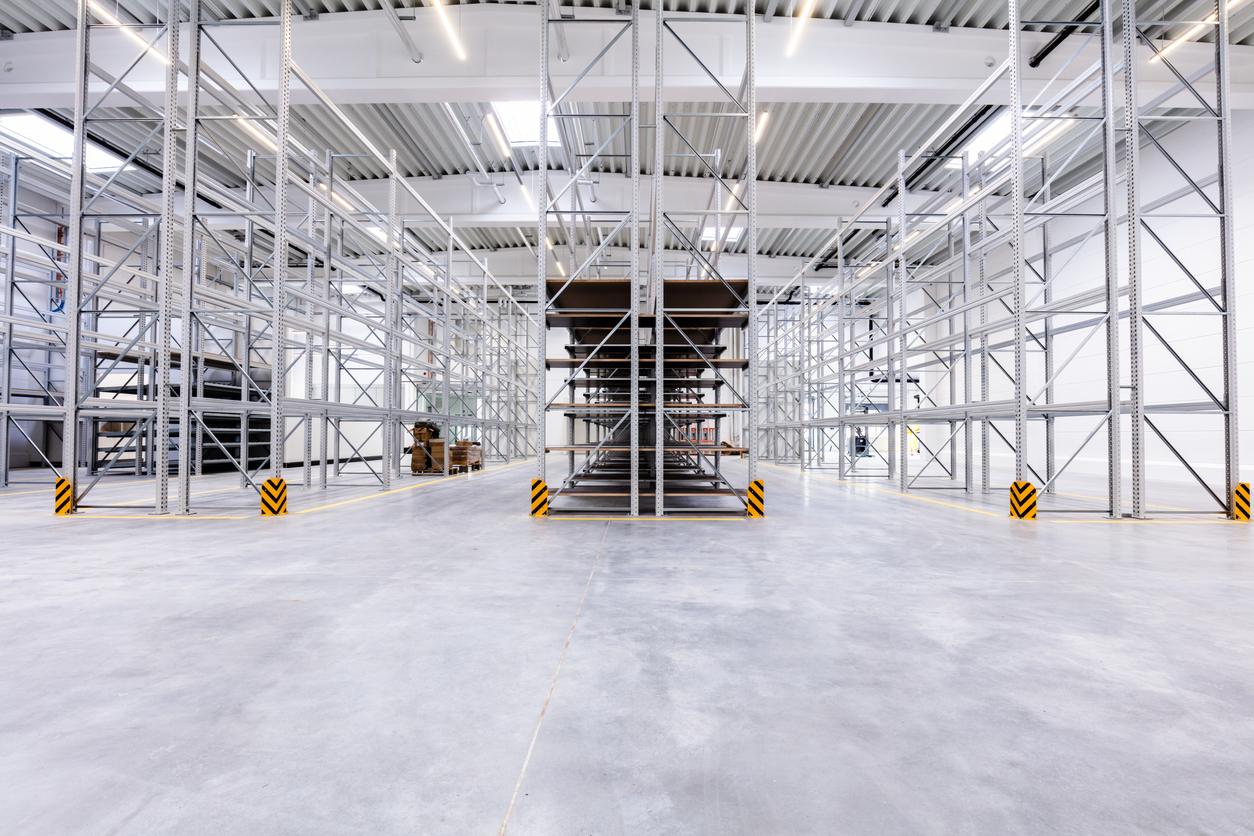
When assigning a new warehouse, it’s common practice to underestimate what is needed for pallet storage (pallet racking) by a large margin, purchase accordingly, then for the next couple of years, proceed to work around a system that is inadequate, resulting in a huge waste of potential profit. Working out the numbers before you engage with the racking supplier is a game changer, and here’s the important points to get you started.
Determine Your Toughest Pallets
This will be the most important step. With the most difficult pallet assumed, you’ll need to describe the dimensions and the weight to the racking system. Pallet racking systems normally load based on the worst case scenario, not a typical use case.
The dimensions of a typical UK pallet are 1200 x 1000 mm, but there are way more operations running 1200 x 800 mm Euro style pallets (or non-standard for another reason). If you are shifting multiple pallets, do not assume and instead, measure.
It is crucial to understand the weight. Standard pallet racking systems assume that the weight is evenly distributed. This means the weight, instead of leaning towards the back, should equally weigh the front.
Determine How Many Pallet Slots You Need
As a rule of thumb, buffer your shelf system by 20 to 25 percent more from the highest load you expect to see on your system. Then, think about how many pallet slots you need. A pallet slot is equivalent to a single pallet space on a single shelf.
To leave room for future growth, plan for a minimum of 240 to 250 positions when currently running 200 pallets.
Picking faces, empty positions for returns, quarantine stock, and slower moving lines occupy more capacity than expected and should all be planned for.
Determine your usable ceiling height.
Your racking doesn’t reach the ceiling due to the ceiling gap being filled with various things.
Your ceiling’s highest point can’t exceed ceiling level and be more than 150mm below sprinkler heads (and more with less fire safety controls). This is an example of something catching people out that significantly limits their height of usage.
Height is reduced even more by lighting, structural support, HVAC, and other ceiling top systems. Measure to the highest of those systems and not to the highest point of the ceiling.
Your usable racking height is whatever is left after measuring it against the height of your tallest filled pallet.
Consider your handling equipment.
This is the point where you must go to the calculated specifics of your floor space. The needed aisle width is entirely based on handling equipment and what’s moving in it.
In smaller warehouses, the typical width needed for safe operation of a counterbalance forklift is between 3,500mm to 4,000mm. However, reach trucks can operate in aisle widths from 2,700mm to 3,000mm, while very narrow aisle (VNA) trucks can operate in aisles ranging from as small as 1,600mm to 1,800mm. These are specialist equipment, and the racking must also be configured for VNA.
If there hasn’t been an equipment-run conversation, designing racking around reach trucks and finding later that inter-workings require full reach trucks is an expensive discovery.
Designing a racking system is an iterative process, and aisle width must also be incorporated in back-to-back clearance. There is a typical amount of 200mm back clearance to pallet overhang, and forklift entry angles must also be considered.
Create your plan
In a standard selective racking system, a single bay holds three 900mm pallet units and is 2,700mm wide, while a dual bay system (Euro pallet operation) is 2,400mm wide.
First created your plan by designing aisles. Once aisles have been designed, vertical reticulated spaces can be designated for racking. From there, estimate the number of spaces that can be utilized.
If that number doesn’t satisfy your requirement, you can either adjust the layout, upgrade your racking system, or conclude that the building is too small. All three options should be on the table, as it’s better to know your available options before purchase.
Breaking down the process is common when people forget to consider the equipment’s dimensions or the building’s dimensions. People forget about the sprinklers or they perfectly measure the building for the current stock and find the dimensions of the building to be constricting.
People also tend to forget that not all pallet positions are the same. The level of a pallet rack system affects how a pallet rack system is picked. For a high-pick operation, the ratio of lower-level positions to upper-level positions is often important. If the pallet system is designed to store a pallet load with very infrequent movement, the ratio will often not be a concern.
None of this should be a concern once you process it once. If you have a concern and don’t know where to start, a site survey will encompass all, but having your dimensions for the survey will help settle the concerns for both parties.